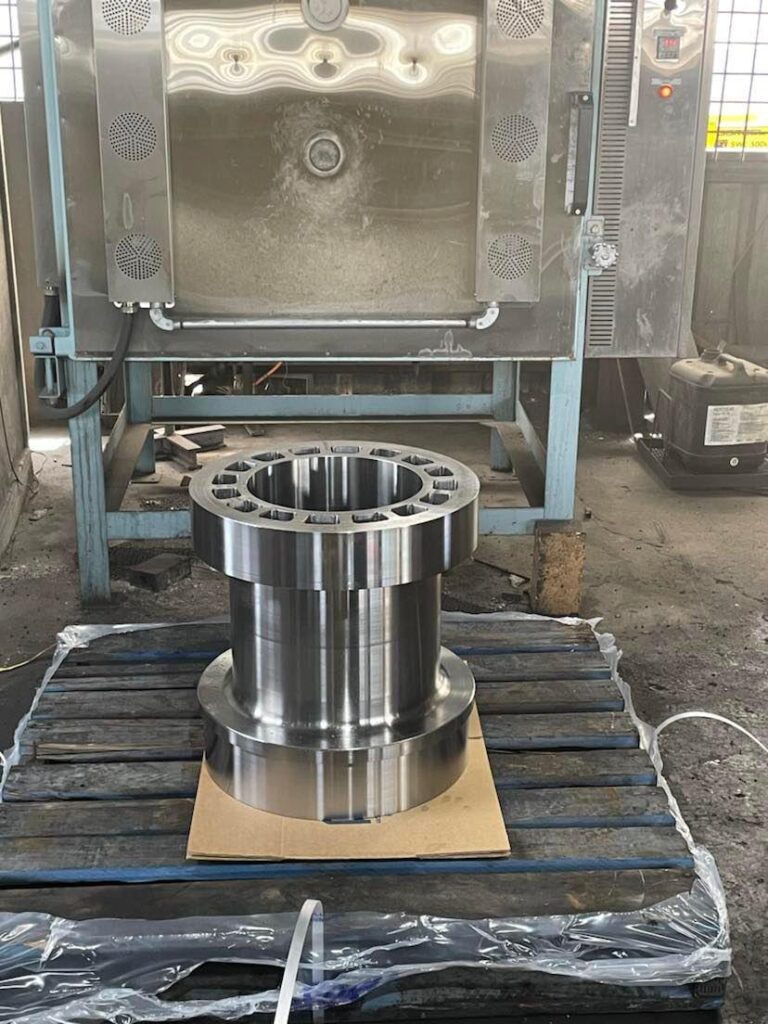
Annealing, Normalizing and Stress Relieving
The primary purpose of an annealing treatment is to reduce the hardness of a material and facilitate the progress of subsequent manufacturing operations. Annealing is commonly used after casting, forging or rolling to soften materials and minimise residual stresses, improve machinability, and increase ductility by carefully controlling the microstructure. Many steels in strip form are annealed, as are most tool steels and stainless steels. Non-ferrous alloys are also annealed.
There are several process variations that qualify as annealing treatments:
Full annealing is performed on steels by heating to a high temperature (typically 830-950°C), then cooling slowly to ambient temperature. Non-ferrous materials are softened and refined by fuII annealing at temperatures appropriate for each alloy.
Isothermal/cyclic annealing is performed by heating steels to the full annealing temperature, cooling to an intermediate temperature (typically 550 – 700°C) and soaking for a long period to allow transformation to proceed slowly, followed by cooling to ambient temperature.
Intercritical annealing is applied by heating steels to below the full annealing temperature (typically 723- 910°C) according to composition. A prolonged soak is followed by cooling to ambient temperature.
Subcritical annealing takes place at a temperature for steels of typically 650 – 720°C, allowing a prolonged soak before cooling to ambient temperature.
Homogenisation annealing can be applied to both ferrous and non-ferrous materials and is a prolonged high-temperature soak intended to break down segregation in the material’s structure.
Solution annealing is applied commonly to austenitic stainless steels, typically at 1010-1150°C. With unstabilised grades, the treatment must be followed by fast cooling or quenching. It is applied as a softening process during manufacture or to optimise corrosion resistance (e.g. after welding).
Stress Relieving
Stress relieving is applied to both ferrous and non-ferrous alloys and is intended to remove internal residual stresses generated by prior manufacturing processes such as machining, cold rolling and welding. Without it, subsequent processing may give rise to unacceptable distortion and/or the material can suffer from service problems such as stress corrosion cracking. The treatment is not intended to produce significant changes in material structures or mechanical properties, and is therefore normally restricted to relatively low temperatures.
Carbon steels and alloy steels can be given two forms of stress relief:
Treatment at typically 150-200°C relieves peak stresses after hardening without significantly reducing hardness (e.g. case-hardened components, bearings, etc.):
Treatment at typically 600-680°C (e.g. after welding, machining etc.) provides virtually complete stress relief.
Non-ferrous alloys are stress relieved at a wide variety of temperatures related to alloy type and condition. Alloys that have been age-hardened are restricted to stress relieving temperatures below the ageing temperature.
Austenitic stainless steels are stress relieved below 480°C or above 900°C, temperatures in between reducing corrosion resistance in grades that are not stabilised or low-carbon. Treatments above 900°C are often full solution anneals.
Normalising
Applied to some, but not all, engineering steels, normalising can soften, harden or stress relieve a material, depending on its initial state. The objective of the treatment is to counter the effects of prior processes, such as casting, forging or rolling, by refining the existing non-uniform structure into one which enhances machinability/formability or, in certain product forms, meets final mechanical property requirements.
A primary purpose is to condition a steel so that, after subsequent shaping, a component responds satisfactorily to a hardening operation (e.g. aiding dimensional stability).
Normalising consists of heating a suitable steel to a temperature typically in the range 830-950°C (at or above the hardening temperature of hardening steels, or above the carburising temperature for carburising steels) and then cooling in air. Heating is usually carried out in air, so subsequent machining or surface finishing is required to remove scale or decarburised layers.
Air-hardening steels (e.g. some automotive gear steels) are often “tempered” (subcritically annealed) after normalising to soften the structure and/or promote machinability. Many aircraft specifications also call for this combination of treatments. Steels that are not usually normalised are those which would harden significantly during air cooling (e.g. many tool steels), or those which gain no structural benefit or produce inappropriate structures or mechanical properties (e.g. the stainless steels).